Skip to content

Posts tagged ‘France’

No. 48: Licking the Windows

An ideal way to spend these mild but crisp fall days is to lick the windows around town. Yep. That’s what the French call window-shopping: licking the windows (en français: faire du lèche vitrine). It’s absolutely the perfect phrase as the shop windows in France are so beautifully delicious, you almost want to eat them up, or at least take home a little taste.

IMG_0119

No. 47: le Sandwich

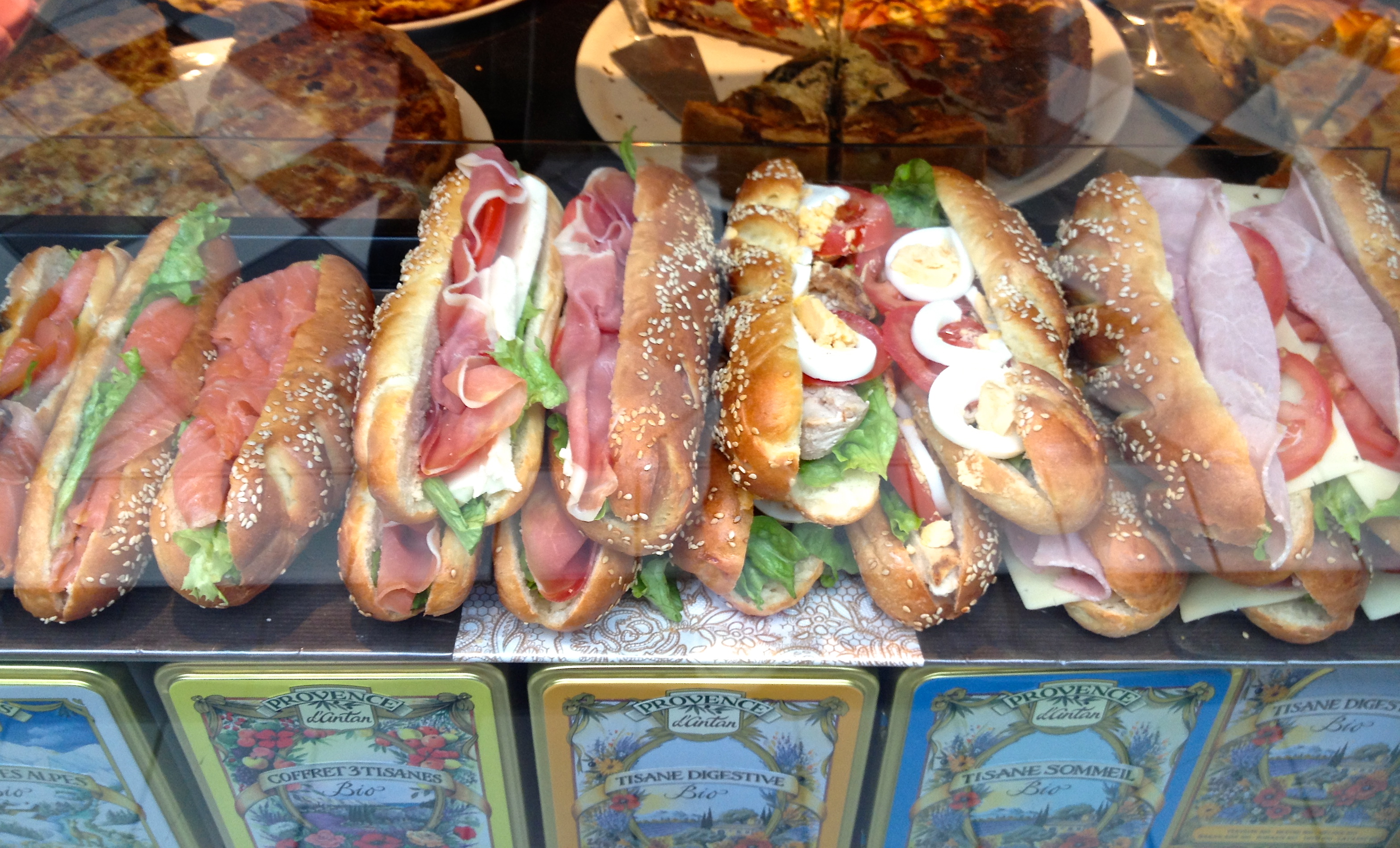
IMG_2069I’m not a big fan of sandwiches in America unless it’s the day after Thanksgiving: juicy turkey, mayo and freshly ground pepper, or Boxing Day when the Christmas honey ham is cold and the Dijon mustard is flowing. Mais en France, it’s easy to become addicted to le sandwich, the Frenchie’s fast-food. Bien sûr, it has a heck of a lot to do with the warm, crusty baguettes, but for me, it also has a lot to do with the ingredients and the lack of traditional condiments.

I’ve heard that France’s national sandwich is the jambon-beurre (ham and butter), but frankly, you can do a lot better than that at any decent boulangerie in France. En fait on the way home from school today I had a Brie de Meaux et figues sandwich (Brie from Maeaux, fig jam, softened figs and walnuts—all on a just from the oven baguette.) C’était délicieux!

Here are some of my other favorites:

Chèvre & Miel: soft cheese, goat’s cheese rounds, baby spinach, honey and walnuts.

Parmesan & Poulet: roasted chicken, tomatoes, arugula, thyme, rosemary, and shaved parmesan.

Bleu & Pommes: blue cheese, fresh apple slices, arugula, raisins, blue cheese sauce.

Roblochon & Porc: Roblochon cheese, smoked pork tenderloin, , salted butter and hazelnuts.

3 Fromages: Brie, emmental, fromage frais (creamy cheese), mustard and honey.

Pont l’Évêque & Jambon: carmelized onions, pont d’évêque (a creamy soft cheese from in Normandy), country ham.

Brie de Meaux & Truffes; Brie, greens, mascarpone truffé, truffle balsamic vinegar.

…and of course, le Croque Monsieur…but that French standard deserves its own post!

Vocabulaire

bien sûr: of course

boulangerie: bakery

C’était délicieux! It was delicious!

en fait: in fact

jambon-beurre: ham and butter

Mais en France…: But in France…

Click here to find my favorite carry-out sandwich shop in Paris.

No. 44-45: Fermé le dimanche & dimanche midi

I love the fact that most shops and many restaurants are closed on Sundays in France. Having lived in the land of 24/7 most of my life, I really appreciate being forced to take a break from consumerism one day a week. However, as a temporary Parisienne, I apparently am out of sync with my fellow citizens.

Sunday has been a day of rest in France since the early 1900s, but according to a recent poll, two-thirds of the population is in favor of stores opening on Sundays (providing it is voluntary for employees to work). Still some see this open-Sundays-movement, like the proposed changes to French vacation and working hours, as an attack on the heart and soul of France, and the essence of what makes France, France.

While the government and the legal system have made it clear that they are not ready to budge or cave into the demands of an always-open world, several French businesses are openly bucking the system, most notable the home improvement chain, Bricorama. They are currently appealing the €100,000 per day fine that has been imposed, and many French families have become vocal advocates of this proposed change which they insist helps working parents, giving them more time to run errands on the weekends.

I am entirely in the other camp. As I’ve said, I’ve been there and I’ve done that. I love that our Sundays in Paris are not just a day of rest, but they are also a day to explore the city or to do something with friends…

…which leads me to another thing I love about France: dimanche midi, or Sunday lunch en famille.

Many French families still gather at their mother’s or grandmother’s house on Sunday afternoons for an old-style, four or five-course meal together. In the past, la maman ou la mamie might have done all the cooking, but these days the guests contribute their own culinary specialties. Which is not to say that they are all homemade, au contraire. Take a ride on the metro late Sunday morning, and you’ll be surprised by the number of travelers carting swanky to-go boxes filled with delicate desserts tied up with silky ribbons. Bottles of wine and bags swollen with cheese, charcuterie, pickled garlic and olives, warm, delicious smelling tartes, roasted chicken, and or course, fresh crusty baguettes, accompany the “déjeuner-ers”.

Our family has quite happily and easily adopted this French tradition, in great part because so much is closed on Sundays in France, and we aren’t distracted by commercial demands or tempted to go out and buy things. Instead, we actually have the time to sit down for a meal together and find out what is happening in each other’s lives.

Sunday lunch is a highlight of my week. My fingers are crossed that the French will choose déjeuner over faire du shopping, and realize the value of fermé le dimanche.

Vocabulaire

déjeuner-ers: déjeuner – to (eat) lunch;  déjeuner-ers—franglish for people who lunch

dimanche midi: Sunday lunch

en famille: with family

faire du shopping: to go shopping

fermé le dimanche: closed on Sunday

la maman: mom

la mamie: granny


No. 43: Les Rosbifs

As I’ve mentioned several times in other posts, I do love the fact that living in France affords me the opportunity to not only visit the United Kingdom, but has also allowed me to make friends with a group of wonderful British women living in Paris. Interestingly I actually seem to fit in better with the British community and the other non-American expats than with my own kind.

Yep, one of the 365 things I love about France is indeed *les rosbifs. I find their humor and candor refreshing and of course, I love their accents. I like their worldliness and global perspective. I like that they provide a reality check on America’s place in the world. I like the fact that their national news is international. And, I love their vocabulary. Why be “great” when you can instead be “brilliant”?

Have a go at these few lines:

Having skived off work and legged it to his mate’s flat, they had a knees up with the neighbors and faffed around. The next morning feeling a bit wonky, the poor bloke was so knackered he had a kip wearing nothing but his pants. Even though it was monkeys outside when he woke up, he popped over to the chemist wearing only his pants and his mac to pick up some nappies, plasters, and bog roll. At least he wasn’t starkers. On the way back home a tosser of a lollipop man stopped him as a long parade of lasses eating fairy cake and candy-floss blocked the street. He thought to himself, this is “total pants”, but not wanting to whinge about it, decide to make the best of a bad situation and pop into a pub for a pint and some bangers and mash.

Have you lost the plot?

Vocabulary:

bangers and mash: sausage and mashed potatoes

blog roll: toilet paper

chemist: the pharmacy/ pharmacist

candy-floss: cotton candy

had a knees up: to go to a dance party

faffed around: dither, waste time

fairy cake: cupcakes

it’s monkeys outside: it’s very cold

kip: sleep or nap

knackered: exhausted

lass(es): girl(s)

leg it: run or run for it

lollipop man/woman: crossing guard

lost the plot: gone crazy

mac: raincoat, short for Macintosh

nappies: diapers

pants: underwear (the Brits say trousers)

plasters: Band-Aids

skive off: evade or avoid something

starkers: naked

tosser: idiot

total pants: nonsense, rubbish, crap

whinge: whine

wonky: not right

**les rosbifs: Calling a Brit a “roast beef” is a French insult in line with the Anglo insult “frog”. I believe it was originally a gastronomic term describing the English style of cooking beef. At some point in history, a French king sent a delegation to England to learn this specialize way of cooking meat. Clearly this was before the French became the culinary champions of the world.


No. 42: London

It may be a bit cheeky to add London to the list of the 365-things-I-love-about-France, but with the ability to jump on a high-speed train and arrive less than 2 ½ hours later smack dab in the middle of the world’s most popular city, it deserves a place on the list.

And if you’re still not convinced that it’s list worthy, consider this French connection: more French people live in London than in Bordeaux, Nantes or Strasbourg. Yep, 400,000 “frogs,” reside in London making it the sixth largest French city in the world!

No. 41: The “Frogs”

While in London this weekend, I asked around about why the Brits call the French “Frogs”. Most people assume the nickname comes from the Frenchies taste for frog legs. However, it turns out there are a whole bunch of different theories about where this term of endearment or offense (depending on your prospective) originated.

Here are a few of my favorites:

The Fleur-de-Lys: During the Middle Ages the French flew a blue flag with a gold fleur-de-lys on it. The English, unfamiliar with the fleur-de-lys, mistook the flower for a frog, and had a right old laugh about a country that would put a gold frog on their flag, and thus began sarcastically calling their nemesis “frogs”.

Elizabeth I & Her Term of Affection: Apparently England’s Queen Elizabeth I had a strong affinity for frogs and often used the word to refer to her closest friends and lovers. At some point one of her dangerous liaisons was with her top diplomat to France, and their juicy correspondence often began with “My dear frog…” Somehow word got out about this term of endearment, and the French became the frogs.

The Swamp: Before Napoleon and Haussmann came in to clean up Paris and transform it into the city we know today, the city was much less the city of light and much more the city of frogs (quite literally). Paris was swampy and therefore full of many little croakers. The now upscale Marais–which means swamp, was in fact a swamp, back in the day, and a very undesirable place to live. The monied-folk living outside of the city in places like Versailles began referring to those who lived in the swamp, as the “frogs”. Foreign ambassadors took a shine to the term, and voilà, the French became the frogs.

Culinary Observations in WWI: British soldiers observed their French comrades odd affection for eating frog legs while serving side-by-side in the trenches, and felt they had no other choice than to call their allies frogs.

Camouflaged Foes: During the next war, WWII, it is claimed that the French resistance fighters were so brilliant at hiding from the Germans, that the Germans began to grumble that trying to find them was like trying to find a frog in a murky pond.

So there you have it. Which do you prefer? Do you know any other stories that explain the amphibian nickname?

Next up: Why the French call the British “roast beefs”…

No. 40: Hidden Gems

I love it when agreeing to do an ordinary favor for a friend turns into a secret discovery. Secret discoveries in Paris are not all that unusual, especially when you make a conscious effort to slow down, take life as it comes, and frankly, just look around.

With 5 million things to do today before I head off for a short trip to visit Kitcat in her new home in Epsom, I agreed to head to a part of Paris I don’t usually hang out in—except when I’m craving the world’s best falafel or need some gefilte fish: le Marais. The delightful French girl Kitcat lives with in the UK was anxious to be reunited with her guitar and I promised to fetch it and carry it across the Chunnel.

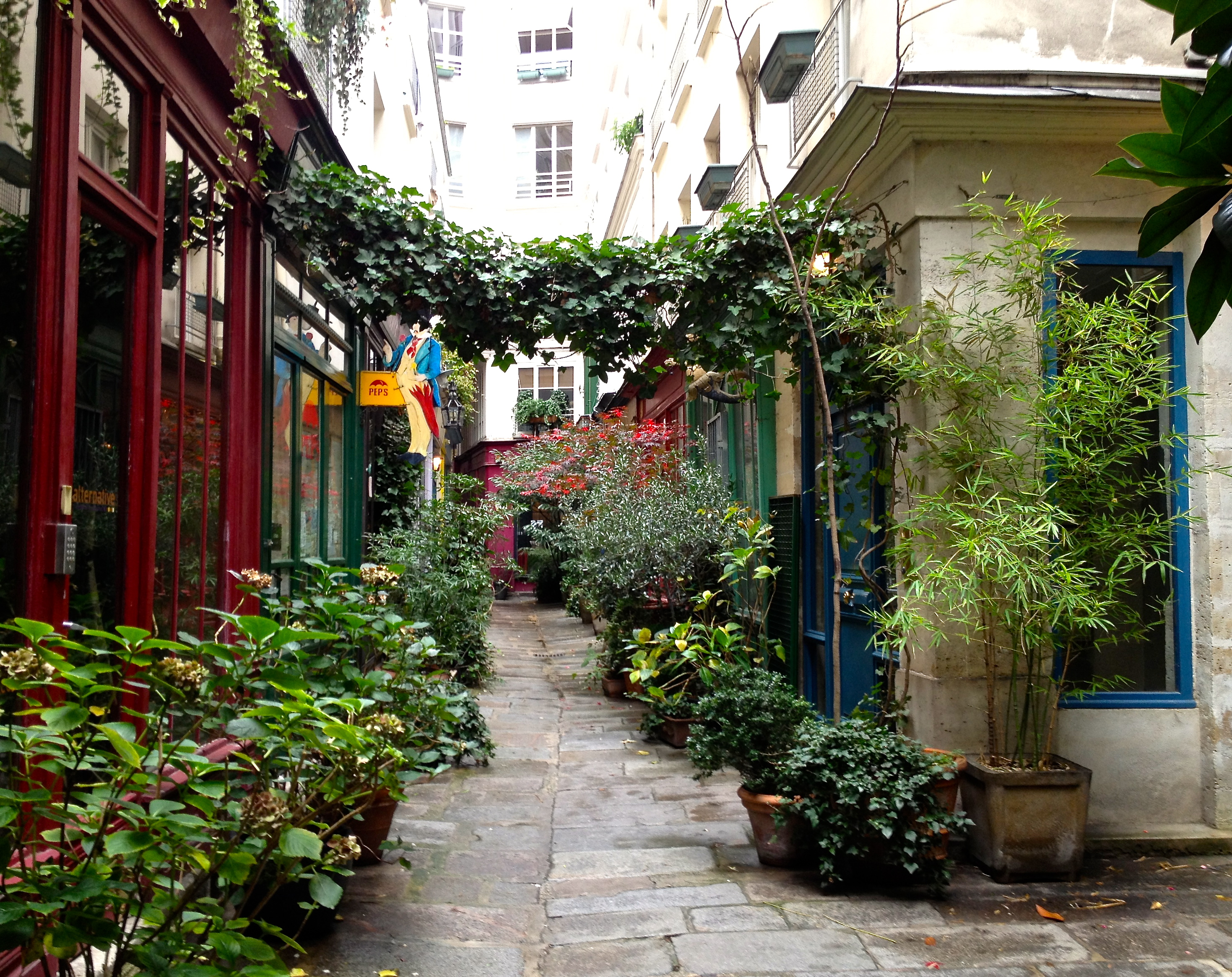
And I’m really glad I did. I ended up in le Passage de l’Ancre, one of the oldest, if not the oldest passageway in Paris. There are hundreds of hidden worlds behind unassuming doors in the French capital, but this one is a real gem. Stepping through the modest blue gates, I was transported to a world that time left behind—Paris at the turn of the 19th century—the stuff of which movies are made. C’est un passage extraordinaire!

IMG_1859

Although the passage was restored 10 years ago, it hasn’t lost its original charm. Bursting with leafy trees, sidewalk planters and lovely window boxes, the brightly colored storefronts are home to a number of interesting workshops and specialty stores. Pep’s, the celebrated atelier, where sick umbrellas and parasols are healed, is the most famous of them, but I’m happy to report that the whole guitar-errand-thing landed me a front row seat to another magical shop, la Bicyclette. Owned by Kitcat’s roommate’s family, I had a guided tour through the past in the tiny, but enchanting workshop of Thierry Marscarell. Nestled among the bicycles, ancient typewriters, antique shoe inserts, sepia-toned photos, wooden oars and skis and of course, bicycles, are modern lights, tempting home decorations, and funky, minimalist adornments. If I had a home in Paris to decorate, this unique store would be my first stop.

IMG_1877

Just a few steps away from le Centre George Pompidou, you can access le Passage de l’Ancre (and la Bicyclette) by two different entrances: 223 rue Saint-Marin or 30 rue Turbigo, 75003.

Vocabulaire

atelier: workshop

C’est un passage extraordinaire! It is an extraordinary passageway.