Skip to content

No. 75: Traditions – la Bûche de Noël

Bûche de NoëlI love the family traditions and special foods surrounding Christmas in France, and this week I had the opportunity to learn a few family secrets. I headed to the kitchen of my friend Marie-Françoise to learn how to make la Bûche de Noël, well actually three different Bûche de Noël…each cake a guarded recipe from three special women, from three different generations.

La Bûche de Noël is the traditional French Christmas cake, shaped like a log, made to symbolize the Yule log. The custom of burning a Yule log at the end of the year dates back to at least medieval times, when villages would gather to celebrate the Winter Solstice. After the shortest day of the year, the log would be lit to acknowledge the coming daylight and to welcome the New Year.

In the early days the Yule log was a carefully selected tree (yes, tree, and traditionally a fruit tree). Once chosen and cut, the bulkiest end was placed into the hearth while the rest of the tree filled the room. The tree was lit using the remains of the Yule log from the year before and burned from Christmas Eve, through the Twelve Days, and was extinguished on the Twelfth night. Whatever was left was stored carefully in the house to bring good luck and protect the family from lightning, of course.

Interestingly, according to Marie-Françoise, the tradition of burning the Yule log in Paris, came to an abrupt halt when Napoleon and his city planning pal, Haussmann decided to gentrify the city by tearing down the disorder and getting rid of the riffraff. The familiar Haussmann apartments, many of which did not have chimneys, replaced them.

Lacking the fireplaces to burn the logs, the culinary-inclined Parisians headed to the kitchen (or perhaps the corner bakery) to create (or pick up) an edible log and continue the tradition in a slightly different way.

As for yesterday, it was great fun learning to make three different varieties of Bûche de Noël, all with sweet and meaningful family memories attached.

No. 74: Père Noël’s Reindeer

…and what about Père Noël and his renne (reindeer)?

reindeer-herd-056-2

source: rukakuusamo.com

Well naturally some of them have different names in French, but to make things even easier for Santa on his big night,  the French have assigned each reindeer an unique attribute, just to make sure things run smoothly…

… et alors, you know…

TORNADE, le plus rapide, the quickest – DASHER

DANSEUR, la plus gracieuse, the most graceful—DANCER

FURIE, le plus puissant, the most powerful—PRANCER

FRINGANT, belle et puissante, the beautiful and powerful—VIXEN

COMÉTE, qui apporte le bonheur aux enfants, who brings children happiness—COMET

CUPIDON: qui améme l’amour aux enfant, who brings children love—CUPID

TONNERRE, le plus fort, the strongest (thunder)—DONNER

ÉCLAIR, qui apporte la lumière, who brings light, (lightning)—BLITZEN

…but do you recall, the most famous reindeer of all…RODOLPHE LE RENNE AU NEZ ROUGE…

rudolph-hermie-

And even though in English, the carol starts by introducing the reindeer one-by-one, in French, it starts this way, while sung to the same familiar tune:

Quand la neige recouvre la verte Finlande,

Et que les rennes traversent la lande,

Le vent dans la nuit

Au troupeau parle encore de lui

When snow covers green Finland

         And reindeer cross the moor

         The night wind

         Still talks to the herd about him…

Take a look here to see the whole song in action. Amusez-vous!


Vocabulaire

Amusez-vous! Have fun!

Père Noël: Father Christmas, Santa Claus

.


No. 73: Fun Christmas Words

It’s been awhile since I’ve done a language post, but I’ve come across several holiday words and phrases in the last few days that have made me grin. Here is a petite sample:

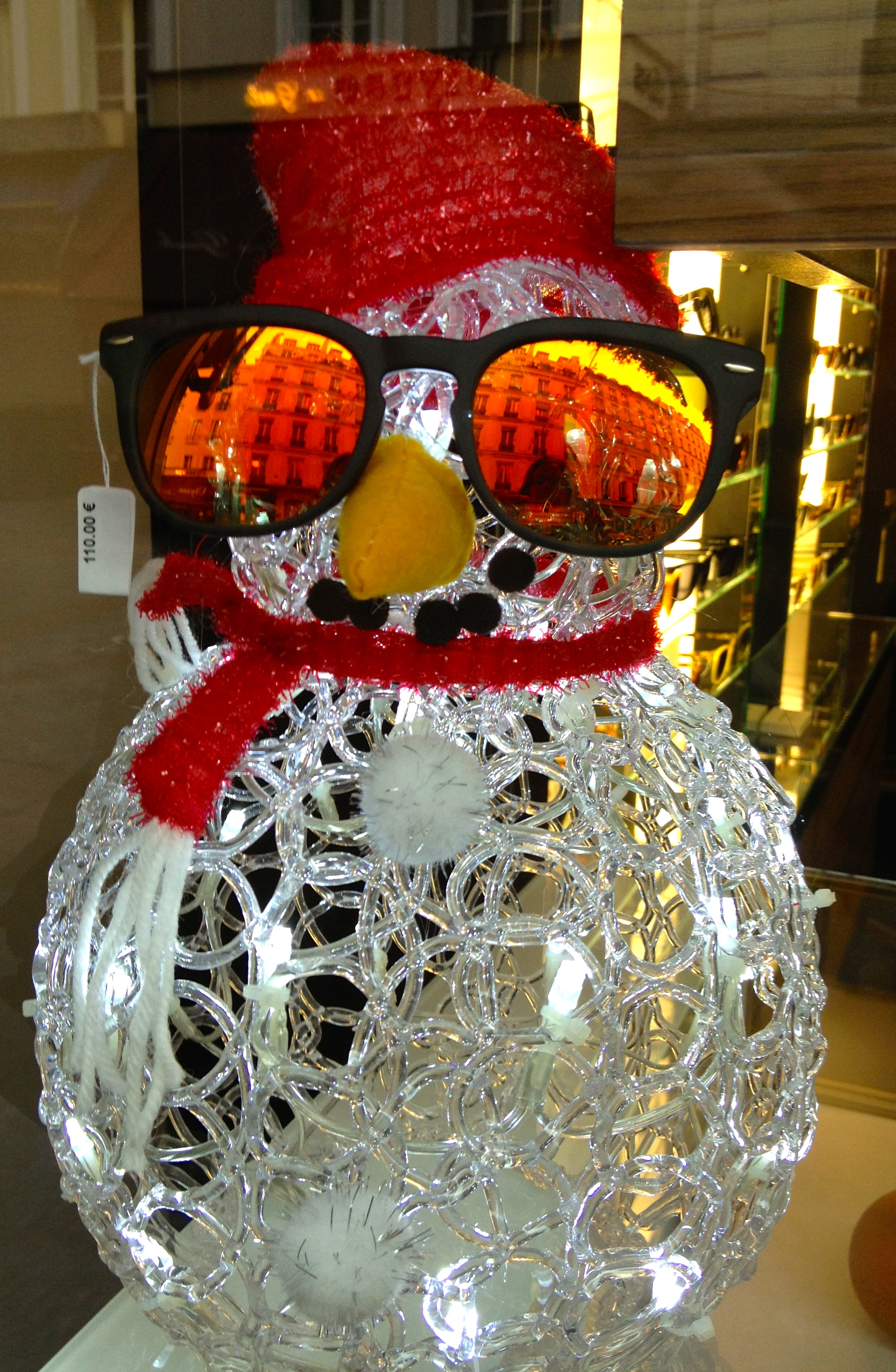
le bonhomme de neige, a good old chap made of snow (or in this case lights)

le bonhomme de neige, a good old chap made of snow (or in this case lights)

  • Un bonhomme de neige: a snowman, but literally a snow “chap”, “fellow”, or “old sport”.  I love the jovial image that one conjures up, and it makes me wonder if a gingerbread man is called “un bonhomme pain d’épice”, because, after all, they are quite jolly fellows too. (Please do let me know.)IMG_2201
  • Noël sous le neige: white Christmas, but literally “Christmas under the snow.” How I love Christmas when it is under the snow!
  • canne à sucre: a candy cane, but literally a sugar stick, nothing like calling a spade a spade.IMG_2218
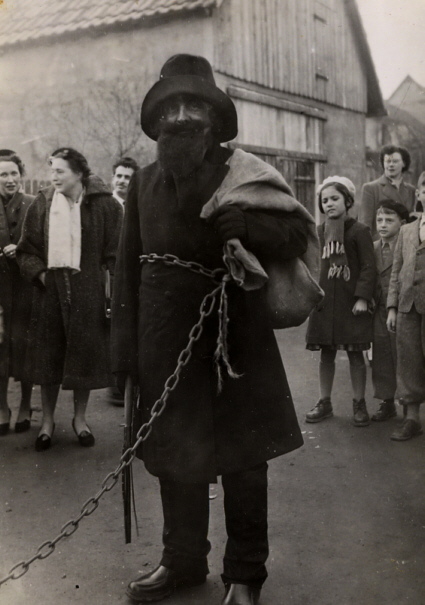
  • Père Fouettard: the boogeyman (who tags along with Saint Nicolas, and depending on the family, hands out coal to the naughty children, or in the worse case scenario, flogs the child); literally “father spanker” or “father whipper”.Hans_Trapp
  • Noël malin: Christmas sales, but literally “shrewd Christmas”; obviously only for those clever enough to shop the sales.

No. 72: la guirlande de Noël

IMG_2468

The French shopkeepers do a marvelous job of gussying up their storefronts for Noël, doing their best to make it the most wonderful time of the year. The decoration of choice is la guirlande. From the grand boulevards to the smallest alleys and passageways, garland is wrapped around doorframes, dangling from awnings and framing candle-lit windows.

It’s easy to recapture that childlike excitement and anticipation at Christmastime in France.

Enjoy the Christmas magic I’ve come across this week.

Vocabulaire

la guirlande: garland

No. 71: Bobbles

Paris is covered in sparkling bobbles en ce moment, et je les adore!

With les boules de Noël in all colors, sheens, and sizes, it’s beginning to look a lot like Christmas…

Vocabulaire

en ce moment: at the moment

et je les adore! and I love them!

boules de Noël: the bobbles, ball-shaped Christmas ornaments

No. 70: Young Artisans, les petits rats de l’opéra

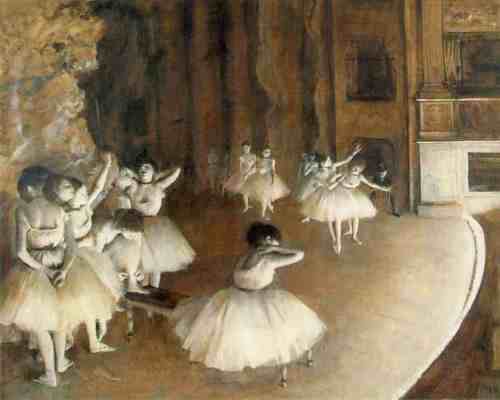
Today I spent the afternoon watching a very young group of artisans at the annual demonstration of the petits rats de l’opéra at the opulent Palais Garnier.

Les petits rats are a select group of students of the Paris Opéra Ballet, all of whom dream of becoming stars, the best of whom go on to become professional dancers in the Paris Opera Ballet Company.

There is limited information on where the term “petit rat” comes from. When I first saw the term, I thought it referred to the fact that the very young students are always cast in the role of the mice in the Nutcracker. But what I learned today, is that the term more likely comes from the dodgy early history of the lives and “careers” of the young children who danced for the opera house.

Louis XIV established the Paris Opera Ballet and School in 1713. En fait, the school is the oldest ballet school in the world and is where classical ballet technique and terminology was standardized. Louis had high hopes for his ballet but unfortunately his drive for excellence took quite a toll on his dancers, especially the children.

The young dancers in training were not the children of the haute bourgeoisie who lived in the elegant quartiers of Paris. Rather, most were children of the working poor who lived in an extremely different world in the marginal quartiers of Paris. They joined the Opéra between the ages of six and eight to help support their families and worked six day weeks like factory workers. Mostly malnourished, with not much more than the clothes on their backs, many of the dancers were forced to supplement their income by offering sexual favors to the abonnés (bourgeois ballet subscribers). Because of their poor living and working conditions, they became known as the “petits rats de l’Opéra”, or the little rats of the Opera.

Nowadays the rats train in a modern, state-of-the-art location in a suburb of Paris, which houses dance studios, classrooms and dorm rooms. Children come from across the economic spectrum. They attend academic courses in the morning and train between four and six hours in the afternoon. They live and breathe ballet, and pretty much give up their childhood in exchange for the hope of becoming l’étoiles. There are still rumors that their lives are not much better than the earliest rats, published reports (denied by the Opéra) have described an extremely grim daily existence at the school.

Still there is no denying the results are magnificent. The children are thrilling to watch. Their strength, poise, talent and stage presences is staggering for such young dancers. It was inspiring, albeit a bit sad after researching the school, to see these young artisans expressing their passion for their craft, and dancing as if it was the only thing in the world worth doing.

Ecole de danse (saison 2010-2011)

Sur cette photo, tu peux voir les “petits rats” de l’Opéra de Paris lors d’un cours de danse avec un de leurs professeurs. (© Agathe Poupeney)

No. 69: l’artisan, Maison Légeron: It’s in the Details

IMG_3538Recently I was lucky enough to have the opportunity to tour an atelier of another unique group of artisans, la maison Légeron.

La Maison Légeron is home to a handful of talented craftspeople (mostly women) that skillfully turn silk into flowers and ostrich feather into finery and create intricate accessories seemingly out of thin air. They do this for the prestigious fashion houses of Paris, Dior, Givenchy, Chanel, Courreges, Ungaro, Lacroix, as well as a number of extremely wealthy clients from around the world.

You might say these are the artisans who take care of the details.

Founded in 1727, Légeron’s handiwork has dazzled the ballrooms of the royals, decorated the bridal gowns of heiresses and princesses, walked the red carpet in Hollywood, and graced the catwalks of all major fashion houses this year.

Their work is rooted in tradition and trusted only to highly trained and certified artists. From the dyeing of each individual flower petal to the sewing of every last bead, it is all done by hand. The results are exquisite and delicate, one-of-a-kind creations, lovingly designed and equally as suited for the Museum of Decorative Arts as for a Chanel gown.

I love baring witness to petite moments of pure imagination and creativity.

Perhaps in my next life I’ll come back as one of these gifted artisans and spend my days creating beauty for the sake of beauty, and making sure that the details shine.