Skip to content

Posts from the ‘French’ Category

No. 74: Père Noël’s Reindeer

…and what about Père Noël and his renne (reindeer)?

reindeer-herd-056-2

source: rukakuusamo.com

Well naturally some of them have different names in French, but to make things even easier for Santa on his big night,  the French have assigned each reindeer an unique attribute, just to make sure things run smoothly…

… et alors, you know…

TORNADE, le plus rapide, the quickest – DASHER

DANSEUR, la plus gracieuse, the most graceful—DANCER

FURIE, le plus puissant, the most powerful—PRANCER

FRINGANT, belle et puissante, the beautiful and powerful—VIXEN

COMÉTE, qui apporte le bonheur aux enfants, who brings children happiness—COMET

CUPIDON: qui améme l’amour aux enfant, who brings children love—CUPID

TONNERRE, le plus fort, the strongest (thunder)—DONNER

ÉCLAIR, qui apporte la lumière, who brings light, (lightning)—BLITZEN

…but do you recall, the most famous reindeer of all…RODOLPHE LE RENNE AU NEZ ROUGE…

rudolph-hermie-

And even though in English, the carol starts by introducing the reindeer one-by-one, in French, it starts this way, while sung to the same familiar tune:

Quand la neige recouvre la verte Finlande,

Et que les rennes traversent la lande,

Le vent dans la nuit

Au troupeau parle encore de lui

When snow covers green Finland

         And reindeer cross the moor

         The night wind

         Still talks to the herd about him…

Take a look here to see the whole song in action. Amusez-vous!


Vocabulaire

Amusez-vous! Have fun!

Père Noël: Father Christmas, Santa Claus

.
 

No. 73: Fun Christmas Words

It’s been awhile since I’ve done a language post, but I’ve come across several holiday words and phrases in the last few days that have made me grin. Here is a petite sample:

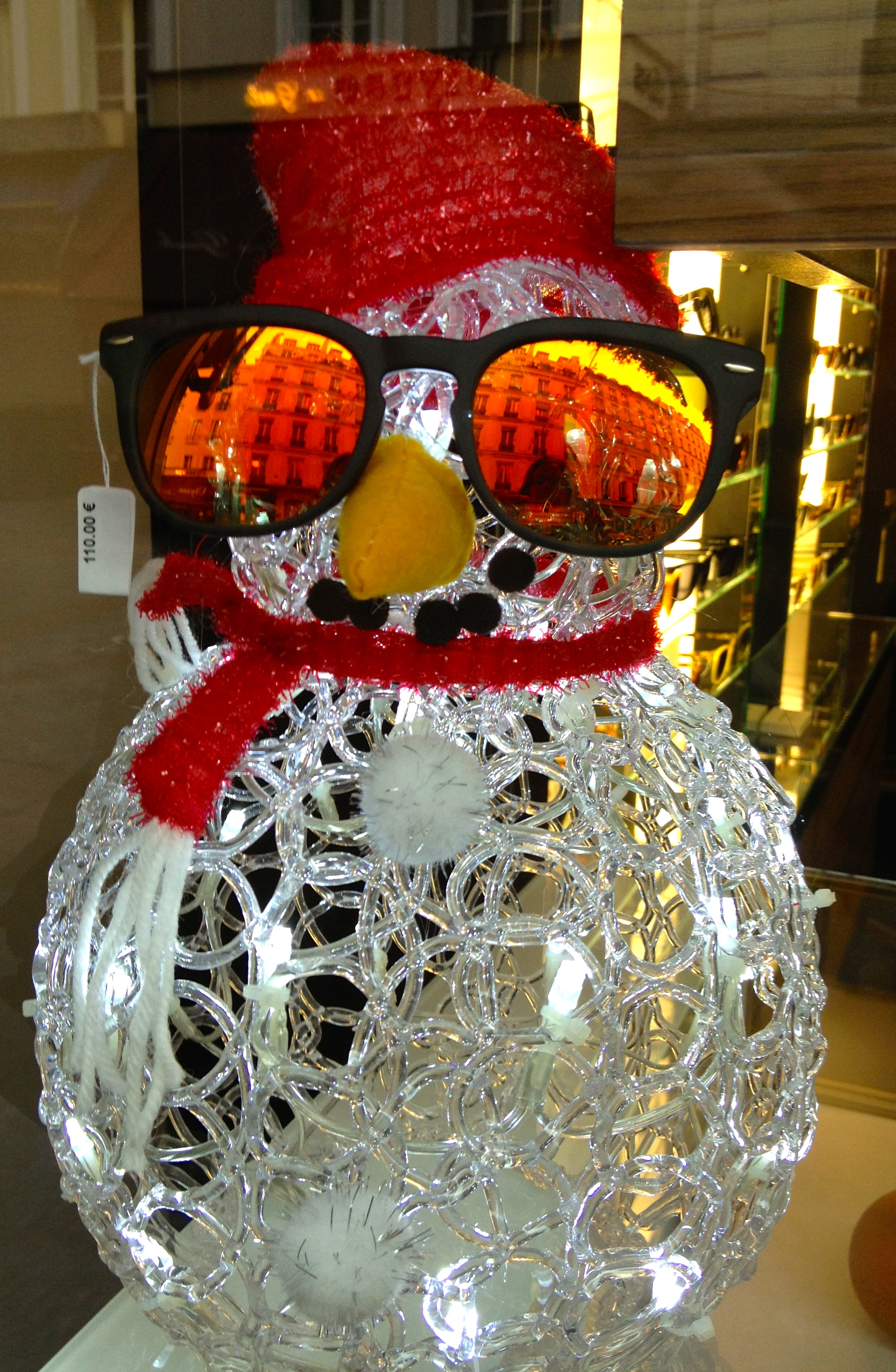
le bonhomme de neige, a good old chap made of snow (or in this case lights)

le bonhomme de neige, a good old chap made of snow (or in this case lights)

  • Un bonhomme de neige: a snowman, but literally a snow “chap”, “fellow”, or “old sport”.  I love the jovial image that one conjures up, and it makes me wonder if a gingerbread man is called “un bonhomme pain d’épice”, because, after all, they are quite jolly fellows too. (Please do let me know.)IMG_2201
  • Noël sous le neige: white Christmas, but literally “Christmas under the snow.” How I love Christmas when it is under the snow!
  • canne à sucre: a candy cane, but literally a sugar stick, nothing like calling a spade a spade.IMG_2218
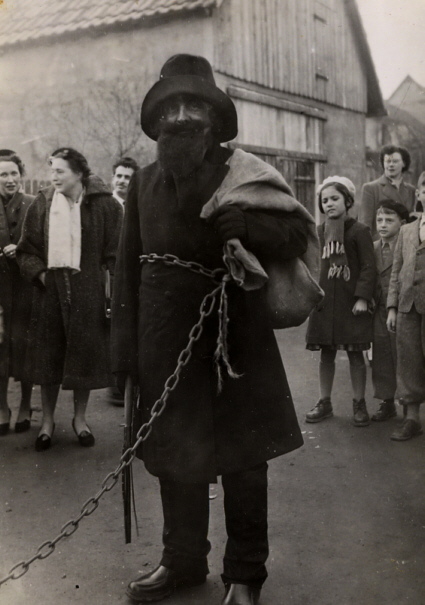
  • Père Fouettard: the boogeyman (who tags along with Saint Nicolas, and depending on the family, hands out coal to the naughty children, or in the worse case scenario, flogs the child); literally “father spanker” or “father whipper”.Hans_Trapp
  • Noël malin: Christmas sales, but literally “shrewd Christmas”; obviously only for those clever enough to shop the sales.

No. 62: American Christmas or French Thanksgiving

The French have reluctantly taken on a few of our American holidays and traditions…Halloween, bachelorette or hen parties, and lavish weddings, for example. Luckily, Thanksgiving is still a mystery to them. As it should be, given that the history of the holiday is exclusively tied to America.

They don’t have a good handle on what it is all about (and I might add, neither do our dear British allies…).

As I set out on my annual scavenger hunt to find all the necessary ingredients for our feast, I watched several shop keepers have their “AHA moments”, when I told them I needed so-and-so for le jour de grâces.

I even tried: le jour de l’action de grâce.

After repeating it several times, a smile would spread across their faces, and they would say, “Madame, vouliez-vous dire Noël américain?”

“No, kind sir, I don’t mean American Christmas! I mean Thanksgiving.”

Humph. Noël américain.”

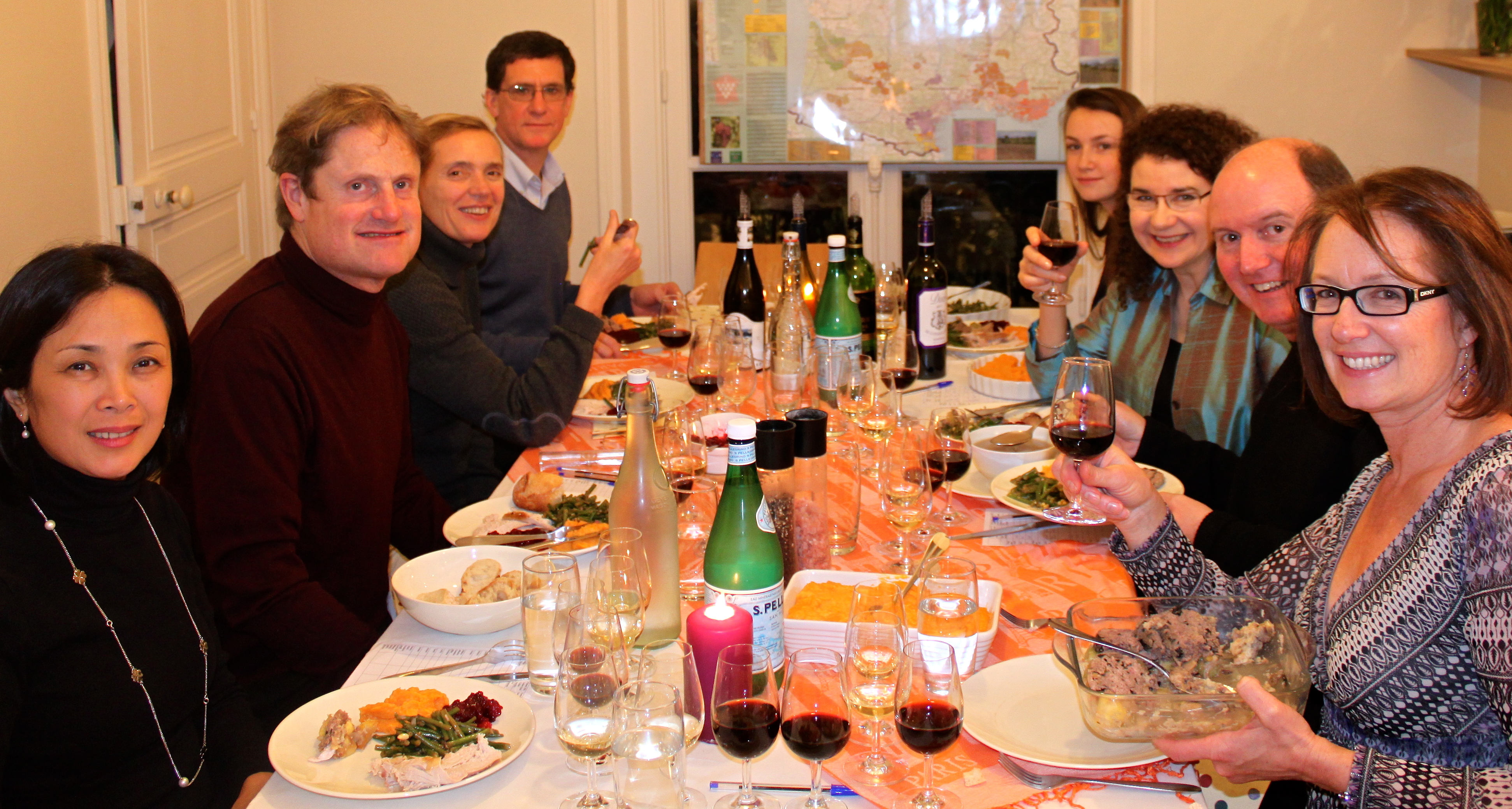
So this year, I decided to celebrate American Christmas in a very French Thanksgiving-ish way. I chose to host a wine tasting Thanksgiving chez nous. Complete with foie gras and strange French farce (stuffing).

IMG_8913

My precious friend and wine expert Hélène chose a yummy menu of four wines (two white and two reds) and a bubbly magnum of champagne to sample over the course of the evening. Who knew wine could taste of grass and honey, dirt and mold, black berries and grapefruit. It was a hoot and a delicious way to remember to be grateful for the wonderful group of international friends we have in Paris…

…and to enlighten a few of our French friends on the finer points of American Christmas Thanksgiving.

IMG_8824

Vocabulaire

le jour de grâces / le jour de l’action de grâce: Thanksgiving

“Madame, vouliez-vous  dire Noël américain?”: “Madam, do you mean American Christmas?”

Noël américain: American Christmas.


Autre Vocabulaire (curtesy of Laura K. Lawless, www.French.about.com)

autumn, fall   l’automne

colony   une colonie

family   la famille

feast   un festin, un banquet

football   le football américain

grateful (adj)   reconnaissant 

harvest   la récolte

horn of plenty   la corne d’abondance

native (adj)   indigène

(Native American) Indians    les Indiens (d’Amérique)

November   novembre

parade   une parade

Pilgrims   les pèlerins

settler   un colonisateur

to share   partager

thanks   les remerciements

Thursday   jeudi

tradition   une tradition

traditional (adj)   traditionnel

treaty   un pacte

tribe   une tribu

Some traditional dishes served on Thanksgiving:

food   la nourriture

bread   le pain

corn   le maïs 

cranberry   la canneberge

gravy   la sauce au jus de viande

mashed potatoes   la purée

pumpkin pie   la tarte à la citrouille

stuffing   la farce

sweet potato   la patate douce

turkey   la dinde 

yam   un igname


No. 57-58: l’Opéra (gâteau) & l’Opéra (Palais Garnier)

I am crazy for the opéra, both the one with the colorful Chagall ceiling and the one with six layers of divine chocolate and coffee cream.

I started buying l’opéra when we first came to Paris because it was the easiest thing to pronounce (and read) at the pâtisserie. Thank goodness for bad handwriting and a language with strings of silent letters, without which I may have never ordered this yummy chocolate prize.

IMG_8708

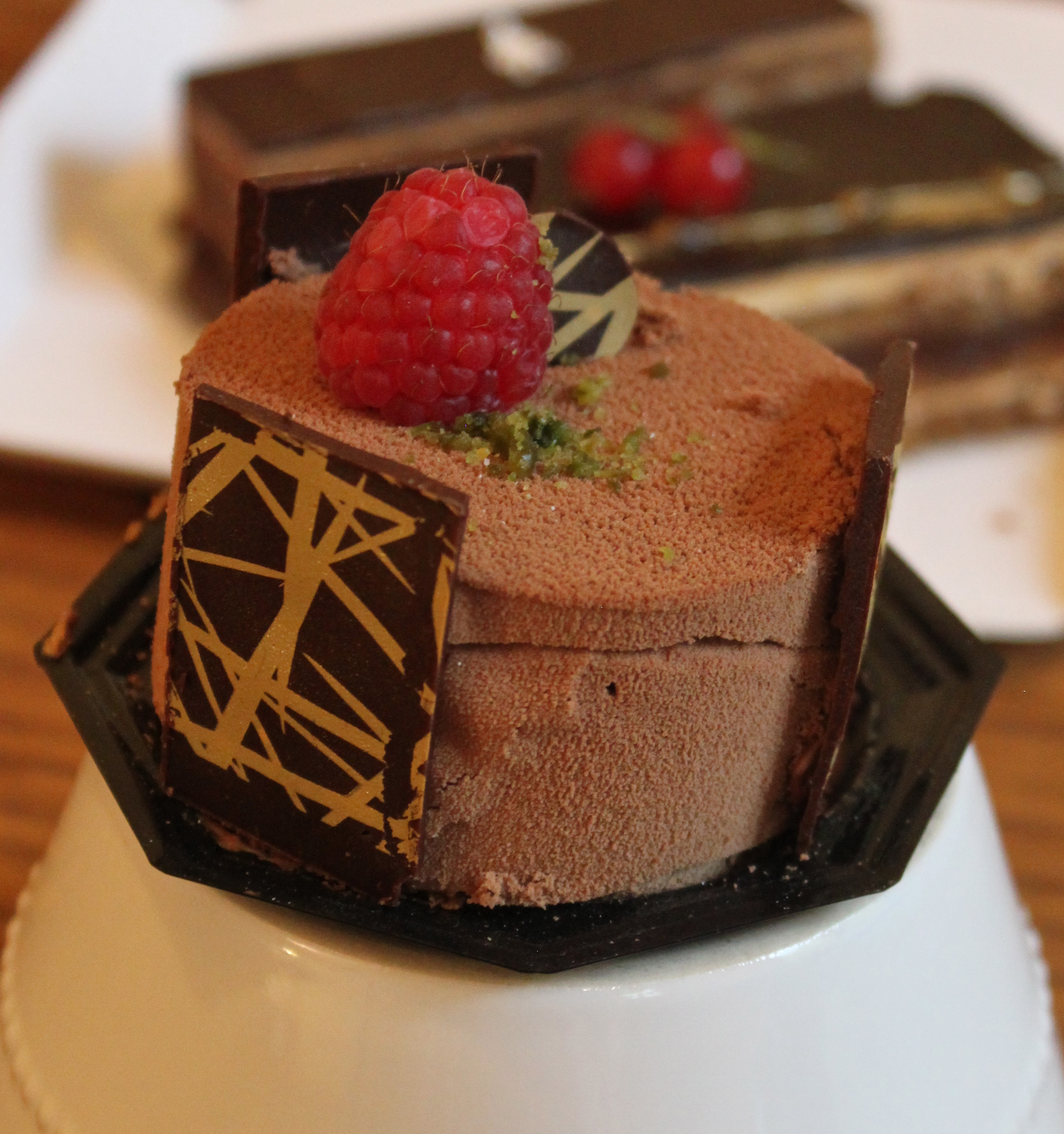
There are several different theories about who invented l’opéra cake and where it was first served. But whether it made its debut in 1890 at the Paris Opéra itself (filled with coffee to keep the audience awake) or in the early 1900s under another name (the Clichy cake), or did not arrive on the pastry stage until the pastry chef at Dalloyau introduced it in the 1950s (honoring a ballerina or the Garnier itself), I’m just glad that some brilliant chef pâtissier came up with this  tasty cake recipe.

The gâteau opéra is a great piece of theatre—a work in six acts, you might say. The play begins with three thin layers of sponge cake soaked in a heady coffee syrup and in between those scenes, a layer of espresso-flavored buttercream, followed by a layer of bittersweet chocolate ganache and concluding with a topping of chocolate glaze. Et enfin, l’opéra is always crowned with some subtle jewel, usually a bit of gold leaf, often toasted almonds, and sometimes the word opéra is delicately penned across the glaze.

My other great love is the real opéra, le Palais Garnier (Garnier Opera House) in Paris. Built on the orders of Napoleon III and carried out by Baron Haussmann as part of the “great Parisian reconstruction”, the opera house is one of the greatest legacies of Napoleon’s reign. Unfortunately for Napoleon, his empire fell before he ever got to ride up in his carriage or had the chance to use his personally designed box seats.

Completed in 1875, the Garnier was the place to see and to be seen. The sweeping staircases were designed so that two finely dressed nineteenth century women could make their grandiose entrances in their grandiose gowns at the same time. Aside from the velvety red theatre, there is a grand foyer that resembles the hall of mirrors at Versailles and is often used by Hollywood when they can’t secure the real deal. If you are a fan of Gaston Leroux’s Phantom of the Opera this is the place for you; the opera house, rumors of haunting, and a vault lake, inspired his story. Marc Chagall’s vibrant ceiling playfully dancing around an 8-ton chandelier is one of my favorite bits of “decoration” is this wildly over-the-top French treasure.

Looking through my pictures this morning of my two beloved opéras, I came up with another theory of why the opera cake was created. I think the two actually resemble one another. Layer after luxurious layer. What do you think?


…if you are going to have l'Opéra, you've also got to have la symphonie…my latest yummy find...

…if you are going to have l’Opéra, you’ve also got to have la symphonie…my latest yummy find…

Vocabulaire:

chef pâtissier: pastry chef

et enfin…and finally

gâteau opéra: opera cake


No. 56: Applause

I love going to the theatre or a concert in France because the French are so splendid at showing their appreciation for artists and performances.

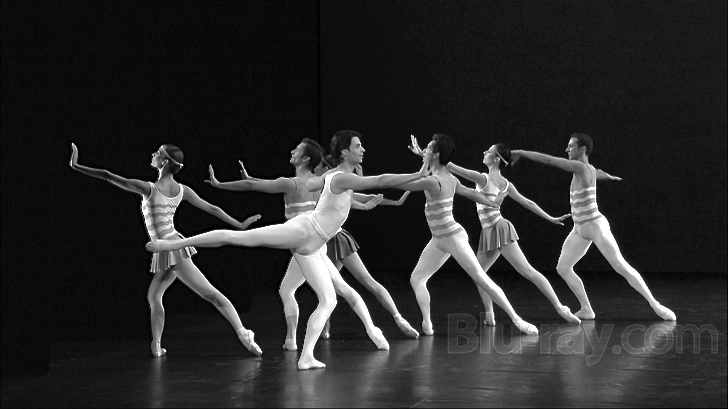
I remember the first performance I attended in Paris 4 years ago at the Opera Garnier. Granted it was the Paris Opera Ballet performing a tribute to Jerome Robbins (Westside Story, King and I, Pajama Game, Fiddler on the Roof…), and destined to be incredible; still I was amazed when the final piece ended and the dancers came out to take their bows. The audience roared with praise in the form of applause. Not just your regular run-of-the-mill applause, but loud and exceptionally long-lasting applause. As the performers came out for one bow after another, the clapping changed from spontaneous random clapping, to the entire audience clapping rhythmically in sync, not letting up until the dancers gave in and performed another short piece.

5720_1 2

Since then, this has been my experience at every piece of theatre I have attended in France, from top-notch professionals to student concerts, from Paris to small villages, from huge audiences to audiences of less than 25. It is not uncommon to clap through 4-5 curtain calls. I’ve clapped for over 15 minutes!

I thought of this very French way of showing appreciation last night when Superman and I went to hear Handel’s Messiah performed by the Paris Choral Society at the American Cathedral. It was a wonderful and very applause worthy performance. After nearly 3 hours, I was ready to give the choir and especially the soloists a good long round of applause.

But something weird happened…that is, it didn’t happen, not in the way I have grown used to. The audience just clapped normally and that was that.

And then it dawned on me, the Paris Choral Society is more than fifty-percent Anglo, and the audience was more Anglo than French. And, us Anglos, well we just don’t know how to do it the way the French do. And that made me a little bit sad.

As a mother of two beautiful girls trying to make it in the musical theatre world, I know how much blood, sweat and tears goes into each and every performance, and I appreciate when an audience appreciates that.

French audiences seem to get it. They recognize and value artists…and that is one more thing that I love about France.

No. 54: un p’tit… / une p’tite…

hopper.com

hopper.com

Now that I’m more in tune with the French (literally, I can finally understand a lot of what the French are saying to me…hurrah!), I keep hearing “un p’tit / une p’tite so and so”… Short, of course for un petit/ une petite.

While I, with my VERY literal grasp on français, find it an adorable habit to make nouns smaller than they actually are by prefacing them with the word “petite”, mes amies françaises have a slightly different take on it.

They seem to be of two minds, or perhaps I should say, they can see both a positive side and a negative side to their compatriots’ linguistic addiction to le p’tit mot “petit(e)”.

On the positive side, when used among close friends, or people you’d like to be close friends with, the word petite, indicates a “closeness” and not  a smaller size. For example, when you invite a few good friends to “une p’tite soirée” (a party), you are implying that it will be a warm gathering among close friends. Un p’tit café  with a friend implies an intimate catching up over coffee (not a tiny cup of Joe), where as an invitation to have un café with an acquaintance or colleague, is more in line with the business end of things.

Among friends you could share une p’tite bière, (beer), une p’tite blanquette de veau, (veal stew), un petit dîner (dinner), or un p’tit verre (a glass of wine). You could go for un p’tit ciné (a trip to the movies), on une p’tite ballade (walk), and, of course, un p’tit week-end, which the French adore. None of these things are necessarily reduced in size or length.

As a form of politeness you could ask your prof une p’tite question, or the cashier at the grocery store might ask for un p’tit signiture for your credit card bill. Both of which imply a certain reticence for disturbing you with a request.

But according to my French friends, the addition of the word petite also has a negative implication. They say that the word petite can be used to negate something that was actually a very pleasurable experience… lowering the bar and the value of a really enjoyable moment. Much as the French will almost always reply, when ask about their opinion of something, that it was: “pas mal” (not bad), rather than daring to articulate that is was pretty darn great, the word petite can take the wind from your sails, and imply that the glass is definitely half empty, and nowhere near full. That’s when un p’tit dîner detours from being a lovely dinner among friends, to a dinner that was pretty boring and hardly worth the time, or at least that’s what you want others to believe.

Mais moi, je préfère to go with the literal and positive translation. I like to imagine that when I’m invited to un p’tit restau (restaurant) that I will be dining in a tiny cozy café with my closest friends, drinking small beers and small glasses of wine and sharing tiny plates of food while laughing large and reveling in vast quantities of friendship.

Vocabulaire

le p’tit mot “petit(e)”: the small word “petite”

Mais moi, je préfère..: But me, I prefer…

mes amies françaises: my French friends

No. 51: Tongue Twisters

funkydowntown.com

funkydowntown.com

Alors, chaque semaine, dans mon cours de français, we spend 30 minutes practicing tongue twister, known to the French as les virelangues.

Les virelangues are silly slogans we are supposed to speak swiftly, satisfactorily, and seriously to assess our skillfulness in successfully saying a succession of similar sounds succinctly.

Our assorted assembly of eight adventurers from across the earth, each with an array of atypical accents, histoires, et angst, ce n’est pas an attractive arrangement.

The mental and physical gymnastics we have to perform to suitably spit out these sentences is not only monumental, madcap and manic, mais also mirthful, meaningless, and modestly miserable.

Oh, we try so hard! And French is not an easy language, but, alas, c’est une langue qu’on aime!

Here’s a sample of a few we’ve been working on…it ain’t pretty:

Dans ta tente ta tante t’attend. (In your tent your aunt is waiting for you.)

Lily lit le livre dans le lit. (Lily reads the book on the bed.)

Poisson sans boisson, c’est poison! (Fish without drink, that is poison!)

Cinq chiens chassent six chats. (Five dogs chase six cats.)

Un taxi attaque six taxis. (A taxi attacks six taxis.)

Même maman m’a mis ma main dans mon manchon. (Even mom put my hand in my sleeve.)

Un gros porc dors au bords le beau port du Bordeaux. (A porky pig sleeps by the beautiful port of Bordeaux.)

Je dis que tu l’as dit à Didi ce que j’ai dit jeudis. (I say that you say to Didi what I say on Thursdays.)

Trois tortues trottaient sur un trottoir très étroit. (Three turtles are trotting down a very narrow sidewalk.)

Ces six saucissons-ci sont si secs qu’on ne sait si s’en sont. (These six sausages are so dry that we don’t know if they are (sausages).)

 Pauvre petit pêcheur, prend patience pour pouvoir prendre plusieurs petits poissons. (Poor little fisherman need patience to be able to catch many small fish.)

Chat vit rôt,
rôt tenta chat,
chat mit patte à rôt,
rôt brûla patte à chat,
chat quitta rôt. (The cat sees the roast. The roast tempts the cat. The cat puts a paw on the roast. The roast burns the cat’s paw. The cat leaves the roast.)

Take a listen here to hear how hard these are to say!

Vocabulaire:

Alors, chaque semaine, dans mon cours de français…: So each week, in my French course…

ce n’est pas: it is not…

c’est une langue qu’on aime: it’s a language we love

histoires: stories, histories

mais: but

virelangues: tongue twisters (une phrase difficile à prononcer)

agapegeek.com

agapegeek.com