“The first principle of architectural beauty is that the essential lines of a construction be determined by a perfect appropriateness to its use.”
— Gustave Eiffel
Anyone who knows me well knows that j’adore la tour Eiffel.
I’ve written a lot about it in the past, and I’ve read many books and articles on its construction. Every time I read something new, I am stuck (again) by Gustav Eiffel and his vision. Because I am a woman obsessed, I just spent the last couple of days, reading even more about this fascinating man and his iconic structures. Every time I tried to stop myself and get on with some paid work, I got sidetracked by another enticing story or structure.
Yes, structures, plural. While most of the world knows him and loves him for his “tragic street lamp”, la tour Eiffel, I am equally enamored with his less known, but certainly not less beautiful, creations.
Born in Dijon in 1832, to a family of weavers, Eiffel graduated from the École Centrale des Arts et Manufactures in 1855 as a civil engineer and began to specialize in constructing with metal. Initially he made his name designing bridges for the French railway network, but as we all know, he didn’t limit himself to bridges only.
Here are some Eiffel’s structures I find most interesting—some already visited, but most on my Gustave Eiffel bucket list:
Passerelle Eiffel Iron Bridge in Bordeaux, France, 1858
At only 26-years-old, Eiffel was the construction designer of an iron bridge in Bordeaux designed to link the Orleans rail station to the Midi rail station. Imagine the spectacle before the bridge was completed, when carriages were transferred between the two stations on a ferry across the Garonne River.
Suspension Bridge, Parc de Buttes Chaumont, Paris, 1867

source: Paris walks
The suspension bridge designed by Eiffel was one of two bridges used to access the park’s “Temple of Sybille” in one of Paris’ most beloved parks. It is 64 meters in length and 8 meters above ground. Unfortunately it is currently closed to foot traffic.
Church of San Marco, Arica, Chile, 1871-1875
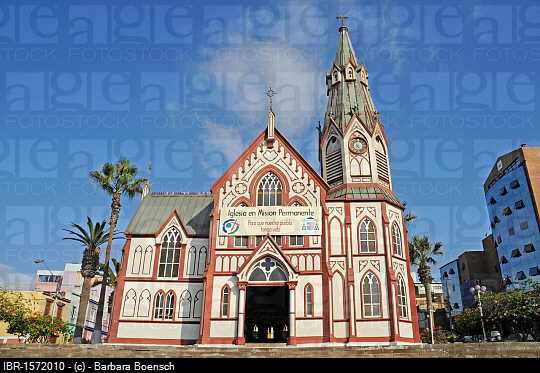
© – Barbara Boensch
In 1871, the Peruvian President José Balta commissioned the workshop of Gustave Eiffel to build this church. The all-metal prefabricated building was manufactured in France and shipped to South America in pieces to be assembled on site.
Bon Marché, Department Store, Paris, 1872-74
Eiffel collaborated with the architect. L.A. Boileau on the first glass and cast iron department store in Paris. This popular and fashionable store still stands, albeit with its masonry skin added in the 1920s.
Les Halles (Dijon Covered Market), Dijon, France, 1875
Beautiful, light and airy, this historic covered market in Eiffel’s hometown features his iconic iron columns and glass and is a wondrous market to visit.
Statue of Liberty, Internal Frame, 1876
When the Statue of Liberty’s initial internal engineer unexpectedly died, Eiffel was hired as the new engineer. Eiffel created a skeletal system for the statue that relied on the internal metal structure to support Bartholdi’s copper plates and sculpture. EIffel and his company built the statue from the ground up and then dismantled it for its journey to New York.
Nyugati Railway Station, Budapest, Hungary, 1877
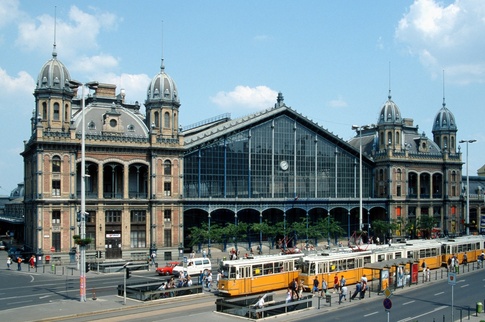
Budapest railway station (www.quora.com)
One of the earliest examples of the combined use of metal and masonry, this train station is definitely high on my list to visit. Where you might have seen it: The 2011 film Mission: Impossible – Ghost Protocol took place in and around this station.
Ruhnu Lighthouse, Estonia, 1877

wikimedia commons
A lighthouse with a red metal cylindrical tower made in the Le Havre plant in France and shipped and reconstructed on the highest spot on Ruhnu Island, in 1877. It is the only lighthouse of its type left in the Baltic Sea region.
Ponte Maria Pia, Oporto, Portugal, 1877

ponte maria pia, portugal (wikimedia commons)
One of Eiffel’s most famous bridges which spans the Douro River in Portugal. No longer in use, two Portuguese architects want to transform the bridge into a monument by moving the disused structure from its present location to the city center (as seen above).
The Eiffel Bridge, Viana do Castelo, Peru, 1878

eiffel bridge, viana do castelo, portugal, 1866 (wikimedia commons)

eiffel bridge, viana do castelo, portugal, 1866, at night, (wikimedia commons)

Two-level bridge, Viana do Castelo, Portugal (source: modestine.blogspot.fr)
The Eiffel Bridge crosses the River Lima near the mouth and connects the city of Viana do Castelo. Its two stories are more than 560 meters in length and a spectacular feat of engineering.
Observatory Dome, Nice, France, 1879
Moving away from bridgework, Eiffel created the dome for the astronomical observatory in Nice, France. It is most notable for a revolving cupola that opens to the sky. The building itself was designed by Charles Garnier (architect of the Opera Garnier and one of the most prominent critics of the Eiffel Tower).
Where you might have seen it: The 1999 film Simon Sez.
Garabit Viaduct, Ruynes-en-Margeride (Cantal), France, 1884

wikimedia commons

1877 (wikimedia commons)
Maybe Eiffel’s most famous bridge, this engineering marvel spans the River Truyère (near Ruynes). It significantly shortened the rail route between Paris and Marseilles.
Where you might have seen it: Henri-Georges Clouzot 1964 film The Inferno (L’Enfer)
The Eiffel Tower, Paris 1887-1889
A subject of another detailed post soon. Meanwhile see: The Sparkling Tower.
Konak Pier, Izmir, Turkey, 1890

konak pier, turkey, 1890 (wikimedia commons)

konak pier, izmir, turkey, 1890 (skyscrapercity.com)
Originally built as a warehouse and French customs office and restored in 2003, it is now an upmarket shopping center, featuring seaside restaurants and cafés.
Ho Chi Minh City (Saigon) Main Post Office, Vietnam, 1886-1891

saigon central post office, 1886-1891 (wikimedia commons)
Designed and constructed by Eiffel when Vietnam was part of French Indochina.

gustav eiffel, liberty park, NY (photo: Suzanne Murphy)
Do you have other favorite Eiffel creations? If so, let me know, I’d love to add them to my bucket list.






 365+ Things I Love About France