Another one of the things I love about France is the country’s dedication to national holidays, especially in the springtime.
While most of my friends and family stateside are back at work today, us lucky folks in France are quietly enjoying Easter Monday sans travail. I remember envying my friends who had kids in Catholic schools when we lived in the Wild West, their children never seemed to be in school.
Now that we live in France, we don’t have to play hooky from school, we can, even as lapsed Catholics, benefit from the excess of sanctioned religious and national holidays during April and May. This is a particularly good year as all the “one-off” spring holidays fall during the week. In fact we only have one full week of school/work during the month of May.
And as I mentioned, today, Easter Monday, is actually a national holiday in this Catholic nation, so even if you’re not a believer, you still get to spend today recovering from the holiday, sort of a vacation from your vacation, which in my opinion is the best way to end a vacation.
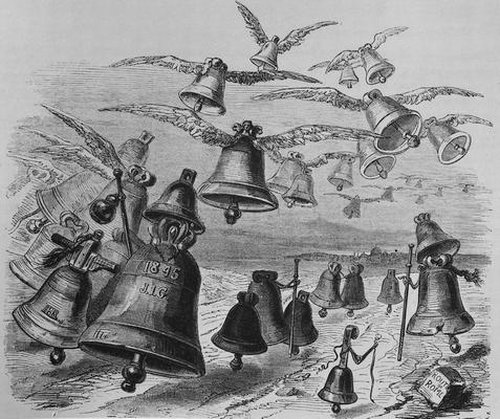
David Sedaris’ Me Talk Pretty One Day is a must read for any expat in France, especially those of us who have taken too many French classes to count, and are still longing to “talk pretty” one day. In this particular excerpt, Sedaris and his global classmates are asked to explain the religious significance of Easter to an Islamic student who has never heard of the holiday. Without having the vocabulary for “cross” or “resurrection” let alone, “He gave His only begotten Son”, the conversation, and I use that term very loosely, quickly degenerates to trying to explain the Easter Bunny, and understand how and why the French Easter Bells fly in from Rome.
Take a listen (or read the transcript below).
It is a dead on and excruciatingly accurate (and hilarious) portrayal of those cringe worthy moments in French class when your dismal vocabulary and tenuous grasp on grammar leads you to say things like:
“He call his self Jesus, and then he be die one day on two . . . morsels of . . . lumber.”
Jesus Shaves by David Sedaris
“And what does one do on the fourteenth of July? Does one celebrate Bastille Day?”
It was my second month of French class, and the teacher was leading us in an exercise designed to promote the use of one, our latest personal pronoun. “Might one sing on Bastille Day?” she asked. “Might one dance in the street? Somebody give me an answer.”
Printed in our textbooks was a list of major holidays alongside a scattered arrangement of photos depicting French people in the act of celebration. The object was to match the holiday with the corresponding picture. It was simple enough but seemed an exercise better suited to the use of the word they. I didn’t know about the rest of the class, but when Bastille Day eventually rolled around, I planned to stay home and clean my oven. Normally, when working from the book, it was my habit to tune out my fellow students and scout ahead, concentrating on the question I’d calculated might fall to me, but this afternoon, we were veering from the usual format. Questions were answered on a volunteer basis, and I was able to sit back, confident that the same few students would do the talking.
Today’s discussion was dominated by an Italian nanny, two chatty Poles, and a pouty, plump Moroccan woman who had grown up speaking French and had enrolled in the class to improve her spelling. She’d covered these lessons back in the third grade and took every opportunity to demonstrate her superiority. A question would be asked and she’d give the answer, behaving as though this were a game show and, if quick enough, she might go home with a tropical vacation or a side-by-side refrigerator-freezer. By the end of her first day, she’d raised her hand so many times, her shoulder had given out. Now she just leaned back in her seat and shouted the answers, her bronzed arms folded across her chest like some great grammar genie.
We finished discussing Bastille Day, and the teacher moved on to Easter, which was represented in our textbook by a black-and-white photograph of a chocolate bell lying upon a bed of palm fronds. “And what does one do on Easter? Would anyone like to tell us?” The Italian nanny was attempting to answer the question when the Moroccan student interrupted, shouting, “Excuse me, but what’s an Easter?” Despite her having grown up in a Muslim country, it seemed she might have heard it mentioned once or twice, but no. “I mean it,” she said. “I have no idea what you people are talking about.”
The teacher then called upon the rest of us to explain. The Poles led the charge to the best of their ability.
“It is,” said one, “a party for the little boy of God who call his self Jesus and . . . oh, shit.” She faltered, and her fellow countryman came to her aid. “He call his self Jesus, and then he be die one day on two . . . morsels of . . . lumber.”
The rest of the class jumped in, offering bits of information that would have given the pope an aneurysm.
“He die one day, and then he go above of my head to live with your father.”
“He weared the long hair, and after he died, the first day he come back here for to say hello to the peoples.”
“He nice, the Jesus.”
“He make the good things, and on the Easter we be sad because somebody makes him dead today.”
Part of the problem had to do with grammar. Simple nouns such as cross and resurrection were beyond our grasp, let alone such complicated reflexive phrases as “To give of yourself your only begotten son.” Faced with the challenge of explaining the cornerstone of Christianity, we did what any self-respecting group of people might do. We talked about food instead.
“Easter is a party for to eat of the lamb,” the Italian nanny explained. “One, too, may eat of the chocolate.”
“And who brings the chocolate?” the teacher asked.
I knew the word, and so I raised my hand, saying, “The Rabbit of Easter. He bring of the chocolate.”
My classmates reacted as though I’d attributed the delivery to the Antichrist. They were mortified.
“A rabbit?” The teacher, assuming I’d used the wrong word, positioned her index fingers on top of her head, wiggling them as though they were ears. “You mean one of these? A rabbit rabbit?”
“Well, sure,” I said. “He come in the night when one sleep on a bed. With a hand he have the basket and foods.”
The teacher sadly shook her head, as if this explained everything that was wrong with my country.
“No, no,” she said. “Here in France the chocolate is brought by the big bell that flies in from Rome.”
I called for a time-out.
“But how do the bell know where you live?”
“Well,” she said, “how does a rabbit?”
It was a decent point, but at least a rabbit has eyes. That’s a start. Rabbits move from place to place, while most bells can only go back and forth–and they can’t even do that on their own power. On top of that, the Easter Bunny has character; he’s someone you’d like to meet and shake hands with. A bell has all the personality of a cast-iron skillet. It’s like saying that come Christmas, a magic dustpan flies in from the North Pole, led by eight flying cinder blocks.
Who wants to stay up all night so they can see a bell? And why fly one in from Rome when they’ve got more bells than they know what to do with right here in Paris? That’s the most implausible aspect of the whole story, as there’s no way the bells of France would allow a foreign worker to fly in and take their jobs. That Roman bell would be lucky to get work cleaning up after a French bell’s dog -and even then he’d need papers.
It just didn’t add up.
Nothing we said was of any help to the Moroccan student. A dead man with long hair supposedly living with her father, a leg of lamb served with palm fronds and chocolate. Confused and disgusted, she shrugged her massive shoulders and turned her attention back to the comic book she kept hidden beneath her binder.
I wondered then if, without the language barrier, my classmates and I could have done a better job making sense of Christianity, an idea that sounds pretty far-fetched to begin with. In communicating any religious belief, the operative word is faith, a concept illustrated by our very presence in that classroom. Why bother struggling with the grammar lessons of a six- year-old if each of us didn’t believe that, against all reason, we might eventually improve?
If I could hope to one day carry on a fluent conversation, it was a relatively short leap to believing that a rabbit might visit my home in the middle of the night, leaving behind a handful of chocolate kisses and a carton of menthol cigarettes. So why stop there? If I could believe in myself, why not give other improbabilities the benefit of the doubt? I accepted the idea that an omniscient God had cast me in his own image and that he watched over me and guided me from one place to the next. The virgin birth, the resurrection, and the countless miracles -my heart expanded to encompass all the wonders and possibilities of the universe.
Continuing on with my non-French cheekiness…I have to share a few more photos of Keukenhof and the tulips from the surrounding villages in Holland. Remember Amsterdam is just over 3 hours from Paris by train, and fares start as low as €70 aller-retour. Another thing to love about living in France.
I had the opportunity to attend an electrifying vocal concert in Paris last weekend.
As you have probably gathered, I love the performing arts and I try to support my children, my friends, and my friends’ children whenever possible. Last Friday was no exception, but it turned out to be exceptional.
Late as usually, I zoomed down to the Marais to support my friend Andrea in her new choral home: VOICES Choir International. And, boy, am I glad I did. Aside from Button’s run in Pasek and Paul’s EDGES last spring, this was the most inspiring and glee-inducing performance I have seen in France.
VOICES Choir International has been around since 1989 and is headed up by the dynamic Bonnie Woolley, an American vocalist and choral director, who exudes the kind of passion and love for her craft that is almost disarming in the often serious world of choral music. Her smile and wit (even en français) is contagious. With her are 40 talented singers from around the globe who give their all. Their repertoire consists mainly of Negro Spirituals and popular and contemporary Anglo-Saxon music. On Friday, it was dedicated exclusively to Spirituals.
I have never seen a group of musicians enjoy themselves and each other so much. I sat there thinking, “Is this much fun legal?” Together in song, they made it impossible for the audience to sit still. I was reminded of the few times I have attended a Baptist church service in the South. They just needed some fabulously bright and ribboned Sunday hats, and I could have been sitting in the pew with my dear friend Sarah in Knoxville, Tennessee.
Do you know the saying: “Live like there is no tomorrow. Dance like no one is watching. Sing like no one can hear you. Laugh like no one is listening.”
Well VOICES does all of the above, but amplified.
I’m not sure if the Spirit moves them, but JOY certainly does.
Look them up the next time you are in Paris or the next time you need to smile and remember the good. You’ll be delighted you did.
Who says the French aren’t HAPPY and fun? C’est pas vrai!
Take a look at all these happy Frenchies dancing around in Montmartre. I LOVE this. I dare you not to smile (and dance). Thanks to Julie and Meeting the French for reminding me that there is a lot of joy in this country.
Vocabulaire:
Ce n’est pas vrai!(C’est pas vrai!) It’s not true!























 365+ Things I Love About France