Skip to content

No. 60: Châtaignes grillées on an open fire…….

IMG_4397

It’s chestnut time of the year in France, and I love roasted chestnuts. In French they are called both châtaignes and marrons…I haven’t figured out the difference between them, or when to use which word. Most signs around Paris say “marrons chauds”, but a French chef friend of mine always says “châtiaignes”. Which ever it is, they are all over town these days…at the top of every metro stop, by all the major tourist attractions, and even on the bridges.

At 1-2€ for a newspaper cone filled to the brim, it’s the perfect healthy snack for a cold day.

No. 59: 29 avenue Rapp, Paris

29 avenue Rapp is one of my favorite buildings in Paris. How lucky I am to live right around the corner from it and pass it nearly every day when I’m out and about. It’s one of those building though, no matter how many times you see it, that still catches your eye and makes you wonder….

And wonder I have until today when, after years of wondering, I decided to find out the 411 on this whimsical piece of eye-candy.

It turns out to be the masterpiece of Jules Aimé Lavirotte, a famous French architect who, working in the early 1900s, designed nine (still standing) buildings in Paris, most of them in the 7ème arrondissement. Obviously he was a master of art nouveau. All of his buildings feature natural but stylized forms, arcs, oval and parabolas, wood, metal, glass, ceramics—mythical and ordinary creatures, realistic but abstract and unexpected.

29 avenue Rapp has all of the above and more. Lavirotte designed this madly decorated facade in 1901 along with his pal Alexandre Bigot, a ceramist. Together, and with the aid of Jean-Baptist Larrivé, a sculptor, this outrageously extravagant building came to life.

And one hundred and twelve years later, it is still teeming with life. The lavish entrance watches the avenue with two huge bug eyes, while a bust of a maiden with an animal pelt wrapped around her neck looks on. The green ceramic, oval windows, and balconies pulse. The shiny bronze lizards scamper and the wooden door sighs. This building has a rhythm—it’s hard to define—you must see it to feel it.

So the next time you are on your way to the Eiffel Tower, take a 10-minute detour and experience 29 avenue Rapp.

No. 57-58: l’Opéra (gâteau) & l’Opéra (Palais Garnier)

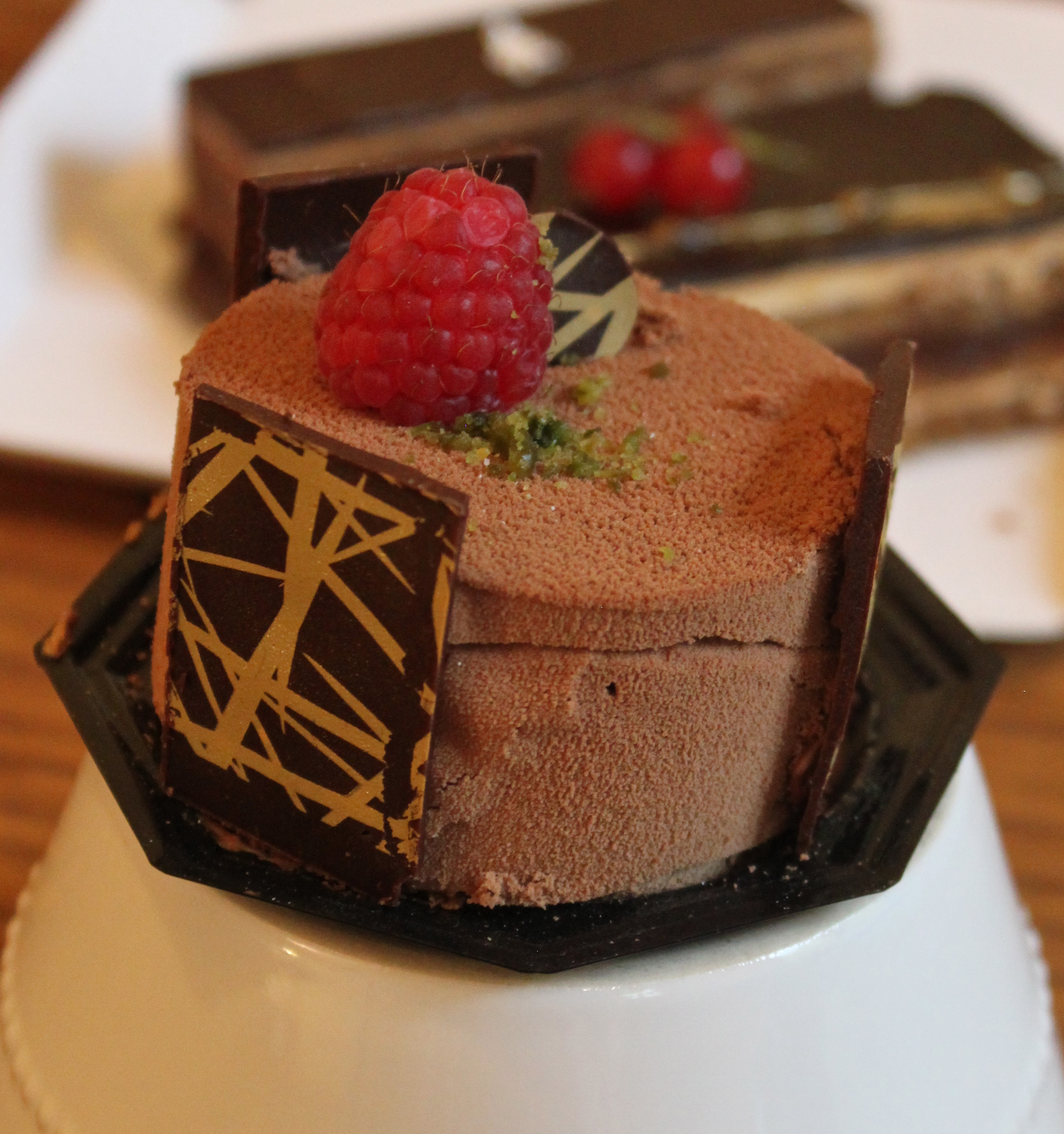
I am crazy for the opéra, both the one with the colorful Chagall ceiling and the one with six layers of divine chocolate and coffee cream.

I started buying l’opéra when we first came to Paris because it was the easiest thing to pronounce (and read) at the pâtisserie. Thank goodness for bad handwriting and a language with strings of silent letters, without which I may have never ordered this yummy chocolate prize.

IMG_8708

There are several different theories about who invented l’opéra cake and where it was first served. But whether it made its debut in 1890 at the Paris Opéra itself (filled with coffee to keep the audience awake) or in the early 1900s under another name (the Clichy cake), or did not arrive on the pastry stage until the pastry chef at Dalloyau introduced it in the 1950s (honoring a ballerina or the Garnier itself), I’m just glad that some brilliant chef pâtissier came up with this  tasty cake recipe.

The gâteau opéra is a great piece of theatre—a work in six acts, you might say. The play begins with three thin layers of sponge cake soaked in a heady coffee syrup and in between those scenes, a layer of espresso-flavored buttercream, followed by a layer of bittersweet chocolate ganache and concluding with a topping of chocolate glaze. Et enfin, l’opéra is always crowned with some subtle jewel, usually a bit of gold leaf, often toasted almonds, and sometimes the word opéra is delicately penned across the glaze.

My other great love is the real opéra, le Palais Garnier (Garnier Opera House) in Paris. Built on the orders of Napoleon III and carried out by Baron Haussmann as part of the “great Parisian reconstruction”, the opera house is one of the greatest legacies of Napoleon’s reign. Unfortunately for Napoleon, his empire fell before he ever got to ride up in his carriage or had the chance to use his personally designed box seats.

Completed in 1875, the Garnier was the place to see and to be seen. The sweeping staircases were designed so that two finely dressed nineteenth century women could make their grandiose entrances in their grandiose gowns at the same time. Aside from the velvety red theatre, there is a grand foyer that resembles the hall of mirrors at Versailles and is often used by Hollywood when they can’t secure the real deal. If you are a fan of Gaston Leroux’s Phantom of the Opera this is the place for you; the opera house, rumors of haunting, and a vault lake, inspired his story. Marc Chagall’s vibrant ceiling playfully dancing around an 8-ton chandelier is one of my favorite bits of “decoration” is this wildly over-the-top French treasure.

Looking through my pictures this morning of my two beloved opéras, I came up with another theory of why the opera cake was created. I think the two actually resemble one another. Layer after luxurious layer. What do you think?


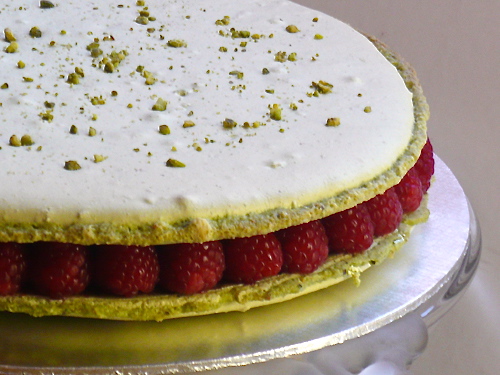
…if you are going to have l'Opéra, you've also got to have la symphonie…my latest yummy find...

…if you are going to have l’Opéra, you’ve also got to have la symphonie…my latest yummy find…

Vocabulaire:

chef pâtissier: pastry chef

et enfin…and finally

gâteau opéra: opera cake


No. 56: Applause

I love going to the theatre or a concert in France because the French are so splendid at showing their appreciation for artists and performances.

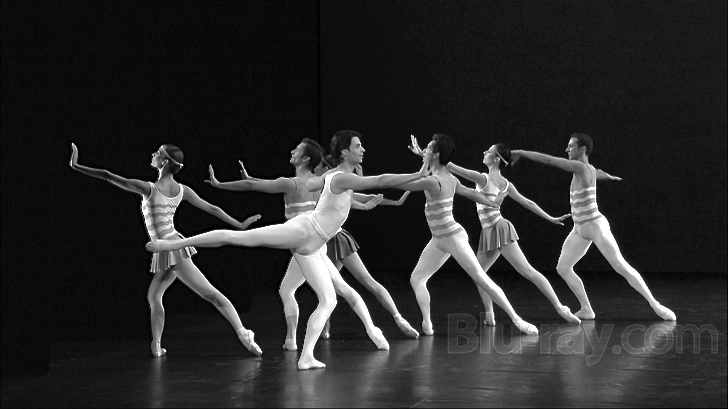
I remember the first performance I attended in Paris 4 years ago at the Opera Garnier. Granted it was the Paris Opera Ballet performing a tribute to Jerome Robbins (Westside Story, King and I, Pajama Game, Fiddler on the Roof…), and destined to be incredible; still I was amazed when the final piece ended and the dancers came out to take their bows. The audience roared with praise in the form of applause. Not just your regular run-of-the-mill applause, but loud and exceptionally long-lasting applause. As the performers came out for one bow after another, the clapping changed from spontaneous random clapping, to the entire audience clapping rhythmically in sync, not letting up until the dancers gave in and performed another short piece.

5720_1 2

Since then, this has been my experience at every piece of theatre I have attended in France, from top-notch professionals to student concerts, from Paris to small villages, from huge audiences to audiences of less than 25. It is not uncommon to clap through 4-5 curtain calls. I’ve clapped for over 15 minutes!

I thought of this very French way of showing appreciation last night when Superman and I went to hear Handel’s Messiah performed by the Paris Choral Society at the American Cathedral. It was a wonderful and very applause worthy performance. After nearly 3 hours, I was ready to give the choir and especially the soloists a good long round of applause.

But something weird happened…that is, it didn’t happen, not in the way I have grown used to. The audience just clapped normally and that was that.

And then it dawned on me, the Paris Choral Society is more than fifty-percent Anglo, and the audience was more Anglo than French. And, us Anglos, well we just don’t know how to do it the way the French do. And that made me a little bit sad.

As a mother of two beautiful girls trying to make it in the musical theatre world, I know how much blood, sweat and tears goes into each and every performance, and I appreciate when an audience appreciates that.

French audiences seem to get it. They recognize and value artists…and that is one more thing that I love about France.

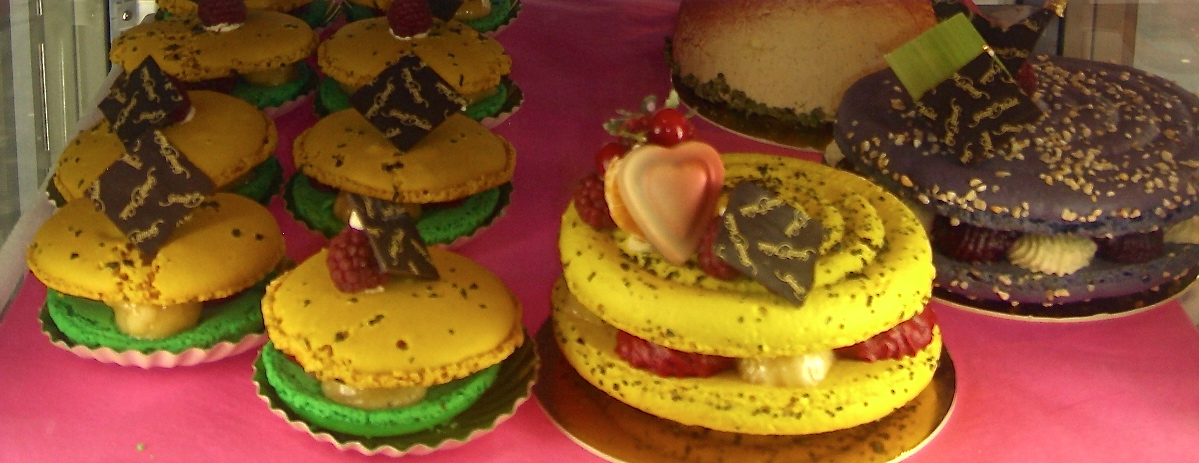
No. 55: Macaron Cakes!

Sloshing home from school today in the rain. I spied these:

Really, what is not to love about a cake-sized macaron?

No. 54: un p’tit… / une p’tite…

hopper.com

hopper.com

Now that I’m more in tune with the French (literally, I can finally understand a lot of what the French are saying to me…hurrah!), I keep hearing “un p’tit / une p’tite so and so”… Short, of course for un petit/ une petite.

While I, with my VERY literal grasp on français, find it an adorable habit to make nouns smaller than they actually are by prefacing them with the word “petite”, mes amies françaises have a slightly different take on it.

They seem to be of two minds, or perhaps I should say, they can see both a positive side and a negative side to their compatriots’ linguistic addiction to le p’tit mot “petit(e)”.

On the positive side, when used among close friends, or people you’d like to be close friends with, the word petite, indicates a “closeness” and not  a smaller size. For example, when you invite a few good friends to “une p’tite soirée” (a party), you are implying that it will be a warm gathering among close friends. Un p’tit café  with a friend implies an intimate catching up over coffee (not a tiny cup of Joe), where as an invitation to have un café with an acquaintance or colleague, is more in line with the business end of things.

Among friends you could share une p’tite bière, (beer), une p’tite blanquette de veau, (veal stew), un petit dîner (dinner), or un p’tit verre (a glass of wine). You could go for un p’tit ciné (a trip to the movies), on une p’tite ballade (walk), and, of course, un p’tit week-end, which the French adore. None of these things are necessarily reduced in size or length.

As a form of politeness you could ask your prof une p’tite question, or the cashier at the grocery store might ask for un p’tit signiture for your credit card bill. Both of which imply a certain reticence for disturbing you with a request.

But according to my French friends, the addition of the word petite also has a negative implication. They say that the word petite can be used to negate something that was actually a very pleasurable experience… lowering the bar and the value of a really enjoyable moment. Much as the French will almost always reply, when ask about their opinion of something, that it was: “pas mal” (not bad), rather than daring to articulate that is was pretty darn great, the word petite can take the wind from your sails, and imply that the glass is definitely half empty, and nowhere near full. That’s when un p’tit dîner detours from being a lovely dinner among friends, to a dinner that was pretty boring and hardly worth the time, or at least that’s what you want others to believe.

Mais moi, je préfère to go with the literal and positive translation. I like to imagine that when I’m invited to un p’tit restau (restaurant) that I will be dining in a tiny cozy café with my closest friends, drinking small beers and small glasses of wine and sharing tiny plates of food while laughing large and reveling in vast quantities of friendship.

Vocabulaire

le p’tit mot “petit(e)”: the small word “petite”

Mais moi, je préfère..: But me, I prefer…

mes amies françaises: my French friends

No. 53: Beaune, Bourgogne

Beaune (pronounced somewhere between “bon” and “bone”) is about 20 mile south of Dijon in Bourgogne (Burgundy) and is the informal capital of the Côte d’Or wine region. It’s raison d’être both historically and nowadays truly seems to be wine. It’s a great place to make wine, buy wine, taste wine and of course, drink wine.

IMG_8688

Luckily we arrived as the tourists had already gone home for the season and were able to enjoy the ancient feel of times-gone-by in this well-preserved walled town. Its windy cobbled streets and friendly squares sprinkled with cafés make it a splendid spot to ponder the rich historical and architectural heritage of the area, while sampling the region’s wine. And the wine is indeed quite fine. I have a French friend (born in Bourgogne, bien sûr) who has told me several times that Beaune is “the” best place in all of France for wine tasting. Surrounded by some of the world’s most celebrated wine villages, I would say, she definitely has a point.

In addition to being located smack dab in the middle of Burgundy wine country, Beaune also houses a marvelous Hôtel-Dieu, which dates back to 1443! Burgundy’s Philippe le Bon and his wife created this medieval charity hospital for the poor after the end of the 100 Years War. Although it is a bit dowdy and unassuming from the outside, once you step inside the courtyard you will delight in the intricate and colorfully tilled roofs, the lacy dressings and the inordinate number of weathervanes. It is a super interesting visit , one which I highly recommend.

If you are traveling without a car, it’s very easy to get to Beaune by train—only 30 minutes from Dijon, and quite simple to organize a wine tour once there.

carte-france-beaune

Vocabulaire

bien sûr: of course, naturally

Hôtel-Dieu: religious hospital, charitable hospital  

raison d’être: purpose, reason for being